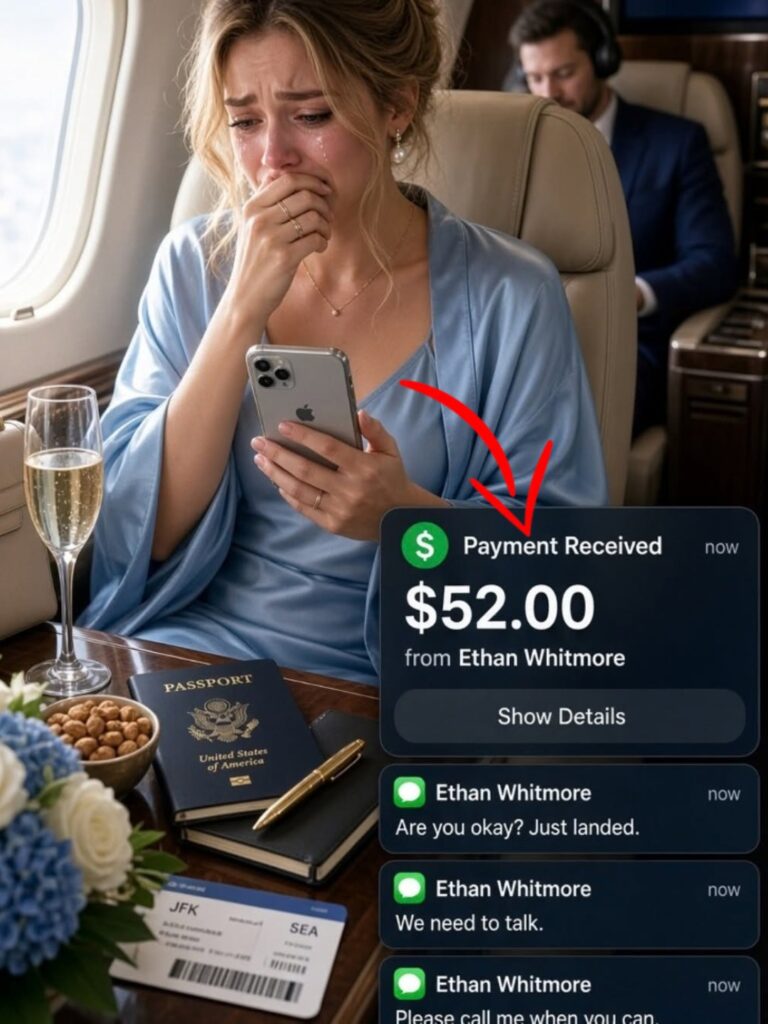
<“My sister didn’t die because of me. And since you refuse to stop making a scene, I sent you $52 as compensation.” I read the message from a seat by the window as the plane prepared to leave John F. Kennedy International Airport. I had only just left a clinic. My womb was empty. My older sister had been gone for fewer than twenty-four hours. And my husband, Ethan Whitmore, the kind of businessman who could spend $25,000 on a dinner without bothering to check the bill, had just transferred $52 to me. Beneath the payment, he wrote: “Vanessa forgot to authorize the hospital payment. I already dealt with her.” Then another message appeared. “But you caused this too. From now on, anything over $250 has to be approved by Vanessa first.” Vanessa Cole was his executive assistant. The woman who answered his calls. The person who decided when I was allowed to speak to my own husband. For years, she had walked into our home without knocking, arranged his flights, selected his restaurants, handled his corporate gifts, and even chose which medications Ethan carried in his briefcase. I stared at the $52. At an airport, it would barely cover coffee and a decent sandwich. My phone vibrated again. “Why aren’t you answering me?” “Come home.” “My grandfather already knows you’re pregnant.” “Claire, stop behaving like a child.” My fingers tightened around the phone. He still had no idea that the baby he was so concerned about was gone too. Three years earlier, I had married Ethan for a reason I hated admitting aloud. My older sister, Emily, had ALS. Our parents died when I was a teenager, and Emily was the one who raised me. She waited tables, sold clothes online, and eventually dropped out of college so she could help pay my tuition. When she became sick, treatments, nurses, medical equipment, and respiratory care consumed everything we had. Then Ethan entered my life. He was a client at the small marketing agency where I worked. One afternoon, he found me crying alone in the parking garage after I received another hospital bill I had no way of paying. He didn’t hug me. He didn’t tell me everything would be okay. He simply asked: “How much do you need?” He paid the bill that night. A week later, he offered me a marriage of convenience. “My family wants me to settle down. You need financial security for your sister. I’ll cover Emily’s medical expenses as long as we’re married.” I agreed. Emily cried when I told her. “Don’t sell your life for me.” “I’m not selling anything,” I lied. “Ethan is cold, but he isn’t cruel.” For three years, I repeated those words to myself. Until Emily developed a severe respiratory infection. The hospital recommended an emergency procedure followed by intensive care. They needed a deposit of nearly $18,000. The card Ethan had given me was restricted when it came to unusually large medical expenses. I called Vanessa. No answer. I called Ethan. Nothing. Finally, I went directly to the offices of Whitmore Group in Manhattan. Vanessa stepped into the executive lobby looking perfectly composed while I stood there pregnant, exhausted, and so frightened I could barely stay upright. “I need five minutes with my husband.” “He’s in a meeting.” “My sister could die.” “Mr. Whitmore specifically asked not to be interrupted.” I grabbed her sleeve. “Vanessa, please. Just tell him I need authorization for the hospital.” She calmly removed my hand. “Mrs. Whitmore, being pregnant doesn’t mean everyone has to drop what they’re doing every time you have a crisis.” For a second, I couldn’t breathe. “If Emily dies…” Vanessa leaned closer. “Maybe then you’ll stop using your sister to keep Ethan tied to you.” I returned to the hospital shaking. That night, Emily held my hand and, with what little strength and breath she still had, whispered: “Don’t ever beg anyone for me again… Live, Claire.” A few hours later, she died. The next morning, I went to Ethan. I asked for a divorce. He didn’t even bother closing his laptop. “Don’t turn this into some dramatic crisis when it can still be fixed.” “Emily died.” He finally looked up. For the first time, genuine confusion crossed his face. But then he said something that destroyed whatever remained of our marriage. “I was the one who ordered her medical spending temporarily frozen. Vanessa was following my instructions. You needed to understand that you can’t keep showing up at my office making scenes whenever you want money.” I stared at him. I didn’t scream. I didn’t argue. I simply walked away. That afternoon, I went to an authorized clinic. For illustration purposes only That evening, I bought the first available ticket to Seattle, where my best friend lived. As the plane began taxiing toward the runway, Ethan sent another message. “If you keep ignoring me, I’ll have Emily removed from the care facility.” I closed my eyes. His threat had arrived too late. Emily was already in an urn. Our baby was no longer inside me. And Ethan still believed both of them were chains he could pull whenever he wanted to force me back home. I turned off my phone. Then I removed the SIM card and snapped it between my fingers. What I didn’t know was that, at that exact moment, Ethan had just entered my sister’s empty room. And he was seconds away from discovering exactly how much treating my grief like an inconvenience was going to cost him. He had no idea what was coming. Ethan arrived at the care facility furious. He pushed open Emily’s door and found an empty bed, neatly folded sheets, and a bare table where her photographs had always been arranged. He stopped a nurse in the hallway. “Where is Emily Parker?” The nurse looked surprised. “Are you family?” “I’m her sister’s husband.” The nurse hesitated. “Then you should know that she passed away yesterday.” Ethan went completely still. He demanded answers. Eventually, he ended up at the hospital reviewing the administrative records. My name appeared again and again. “Claire Parker requests authorization.” “Deposit pending.” “Nine calls placed to financially responsible party.” “No response from executive assistant.” “Patient in critical condition.” “Family requesting extension.” “Payment not received.” Then he saw the recorded time of death. According to what my attorney later told me, Ethan had to sit down. For the first time, he understood that his decision to “temporarily freeze” the money had not been some lesson intended to teach his wife discipline. It had consequences. Real ones. Permanent ones. He went directly back to his office and confronted Vanessa. “Why didn’t you tell me Emily could die?” “I told you Claire was insisting again about another medical expense.” “You never told me it was an emergency!” Vanessa remained remarkably calm. “You told me you didn’t want interruptions.” “Not for something like this.” “You also told me to suspend every authorization connected to your sister-in-law until you gave further instructions.” That was true. And because it was true, Ethan couldn’t simply place all the blame on Vanessa. But there was more. “Did you delete Claire’s messages?” Vanessa hesitated for too long. Ethan accessed the company’s internal system. There were deleted records. Archived emails. Hospital alerts that had never reached him. There was even a voice message I had sent that morning. “Ethan, I don’t want to argue. I just need you to authorize the deposit. Emily is getting worse. Please.” Vanessa had labeled it: “Non-priority.” Ethan fired her. She shot to her feet. “After seven years, you’re firing me because of a woman who married you for money?” “She was my wife.” Vanessa laughed bitterly. “And now you remember that?” Apparently, that question hurt him more than anything else she said. While the two of them were tearing each other apart in New York, I was sitting in my best friend Rachel’s apartment in Seattle, trying to remember how to breathe normally. I slept on her couch because I was afraid of being alone. I would wake in the middle of the night with my hand resting on my stomach. Sometimes, for two seconds, I forgot. Then everything returned. Emily. The clinic. The $52. Rachel never asked whether I planned to forgive Ethan. She drove me to medical appointments. She made soup when I couldn’t eat. And she helped me contact a New York attorney named Michael Bennett. Michael listened to my story over a video call. “We need documentation, Claire. Knowing they behaved cruelly isn’t enough. We need to establish exactly what decisions were made, when they were made, and by whom.” Fortunately, I had saved everything. Bills. Screenshots. Emails. Card restrictions. Rejected requests. Messages from Vanessa. And the $52 transfer. When Michael saw that one, his eyebrows rose. “Financially, fifty-two dollars means almost nothing to a man like Ethan. But if this ever becomes public, those fifty-two dollars could explain this entire story better than a hundred pages of legal filings.” Two days later, something happened none of us had planned. An employee of Whitmore Group posted a video recorded on the day I had gone to Ethan’s office. I appeared in the footage visibly pregnant, pale, and sitting outside the executive elevators. My voice could be heard. “Please tell my husband my sister could die.” Then Vanessa appeared. The recording didn’t capture what she whispered to me. But it captured my face afterward. The video exploded online. “Is that Ethan Whitmore’s wife?” “Why wouldn’t they let her see him?” “Did her sister actually die?” “What did Whitmore Group do?” Michael called me. “We have two options. We say nothing, or we release a statement containing only facts we can prove.” I thought about Emily. I didn’t want my sister turned into entertainment. But I wasn’t willing to let her death be dismissed as some vague “private family matter” either. I authorized the statement. We released hospital records, redacted messages, and proof of the $52 transfer. But what triggered the most outrage was another message Ethan had sent while I was sitting on the plane. “The payment was only delayed by a few days. How serious could it have been?” Within hours, thousands of people were answering the question for him. “Serious enough for a woman to die.” That evening, Ethan somehow obtained my new number. I answered only because Michael had instructed me to record any conversation. “Claire…” His voice no longer carried its usual arrogance. “Talk to my attorney.” “Wait. I know about Emily now.” “Good.” “Vanessa hid information from me.” Anger rose through my chest. “Vanessa wasn’t my husband.” Silence. “I know.” “No, you don’t. For three years, you allowed another woman to decide whether my pain was important enough to reach you.” Ethan’s breathing changed. Then he asked: “What about the baby?” I stared through Rachel’s window at the Seattle rain. “Never mention the baby to me again.” “It was my child.” “Then you should have cared about the woman carrying it.” Another long silence. For illustration purposes only Then: “Did you lose the baby?” I closed my eyes. “No. I made a decision.” Nothing came from the other end. Then I told him the truth I had not yet made public. “After burying my sister, I realized I wasn’t bringing a child into a family where money was used to punish people, control them, and decide who deserved to be heard.” Ethan whispered my name. But there was still something neither of us knew. Something that would make our divorce, the scandal surrounding his company, and even Vanessa’s downfall seem like only the beginning. Because when Michael placed the final document recovered from Whitmore Group’s servers in front of me, I realized Emily’s death had been even more preventable than we thought. The document was a standing bank authorization. Ethan had signed it three months earlier. After one of Emily’s previous hospitalizations, he had authorized any respiratory emergency costing up to $25,000 to be paid immediately without anyone needing to contact him first. I had never known that document existed. Neither had the hospital. Vanessa had. Her digital signature appeared in the system, confirming that she had received a copy. Michael explained it carefully. “This changes a lot. The funds were already preauthorized. The hospital should never have needed a new approval unless someone deliberately suspended the arrangement.” “Ethan suspended it.” “Yes. But we need to establish exactly how that happened.” We formally requested Whitmore Group’s internal records. With the media watching everything, the company had almost no room to conceal them. Then the entire chain of messages emerged. The morning I had gone to Manhattan, Vanessa wrote to Ethan: “Claire showed up again about another expense for her sister. She’s disrupting the staff and using her pregnancy to pressure everyone.” Ethan replied: “Freeze everything until she learns to respect boundaries.” Vanessa asked: “Even the automatic medical authorization?” His answer consisted of one word. “Everything.” That word destroyed almost every excuse he could have made. But thirty minutes later, there was another message. Ethan wrote: “If the hospital reports a genuine medical risk, tell me.” Vanessa responded: “Understood.” The hospital reported a genuine medical risk nine times. Vanessa never told him. That didn’t erase Ethan’s responsibility. He had taken a sick woman’s medical treatment and turned it into a weapon for disciplining his wife. But it also proved Vanessa hadn’t simply overlooked a few messages. She had taken a cruel instruction and deliberately pushed it as far as she could. During the internal investigation, another private message was recovered from a conversation between Vanessa and an employee. “As long as her sister stays sick, Claire will always have an excuse to keep Ethan tied to her. Let’s see how long she lasts without access to his money.” When I read it, I had to walk away from the computer. I didn’t feel revenge. I felt nauseated. To Ethan and Vanessa, Emily had become a concept. “Expense.” “Problem.” “Excuse.” Neither of them knew the woman who had worked two jobs so I could have new shoes for school. The woman who sang horribly while making pancakes on Sunday mornings. The woman who, even when ALS began weakening her hands, insisted on choosing her own clothes because she always said: “You can be sick without giving up on yourself.” That was Emily. She wasn’t a line on a financial statement. Michael filed for divorce and initiated the appropriate civil proceedings. He also requested a formal investigation into the deleted communications and interference with medical authorizations. I had only three conditions for any settlement. I wanted my divorce. I wanted Emily’s ashes and personal belongings. And whatever compensation I received in connection with the handling of her medical care would be placed into an independent fund for patients who couldn’t afford emergency treatment. I didn’t want Ethan’s mansion. I didn’t want his cars. I didn’t want ridiculous alimony. After three years of living partly through his money, the only thing I wanted was to never again need someone else’s permission to purchase my freedom. At first, Ethan refused the divorce. His lawyers suggested a six-month separation. Then a year. Then they offered to transfer a luxury townhouse on Manhattan’s Upper East Side into my name. My answer never changed. “I’m not negotiating how much it costs for me to stay. I’m deciding to leave.” Then Ethan did something that surprised even his lawyers. He appeared publicly. No Vanessa. No public-relations representative speaking on his behalf. He stood in front of the cameras himself. “I gave an irresponsible and cruel order. Even though information was later withheld from me, I created the circumstances that allowed this to happen. My wife asked me for help, and I treated her like an administrative problem. There is no explanation that can undo the consequences.” I watched the broadcast from Seattle. Rachel looked at me. “Does hearing him say that make you feel anything?” I thought about it. “Yes.” “What?” “I would have given anything to hear that version of Ethan six hours before Emily died.” That was the unbearable truth about regret that arrives too late. It can be genuine. It can transform someone. But it cannot control the clock. Several weeks later, I returned to New York to collect my sister’s ashes and sign the final divorce settlement. Michael arranged the meeting in his office. Neutral territory. Recorded. Lawyers present. I arrived carrying Emily’s urn in my arms. When Ethan entered and saw it, he stopped near the doorway. He had lost weight. Dark circles shadowed his eyes. For the first time since I had met him, his perfectly tailored suit seemed to belong to a man who no longer knew what to do with himself. “Claire…” “You have ten minutes.” He sat across from me. His eyes moved toward the urn. “I’m sorry.” “I know.” He looked up. “You know?” “Yes. I know you’re sorry now.” That final word made him lower his head. “I’ve replayed that day a thousand times.” “So have I.” “If I had answered…” “You didn’t.” “If I had checked the messages myself…” “You didn’t.” “If I hadn’t given that order…” “But you did.” His eyes filled with tears. Watching him suffer gave me no satisfaction. All I could think was how deeply I might have loved this version of Ethan if he had been capable of sitting beside me and crying while there was still someone left to save. “I can’t sleep,” he whispered. “Neither can I.” “Claire, I’m not going to ask you to come back.” “Good.” He swallowed. “But I want to do something.” I looked down at Emily’s urn. “Some things can’t be repaired by doing something afterward. You just have to carry them.” “Let me carry some of it.” “You can’t.” “I could pay…” He stopped himself. That made me look at him. Finally. He had discovered that money didn’t belong in every sentence. I pulled out the divorce papers. “Sign them.” He stared at the pages. “If I sign these, are you really leaving forever?” “Ethan, I already left.” His hand trembled when he picked up the pen. Then he signed. I didn’t feel victorious. Instead, I felt a vast silence inside me. Like removing a ring after wearing it for years and discovering the mark is still wrapped around your finger. When he finished, he looked at me. “Was the baby a boy or a girl?” The question cut through me. Michael started to intervene. I stopped him. “I don’t know.” Ethan took a shaky breath. “Had you thought about names?” I had. During that flight to Seattle, one boy’s name and one girl’s name had entered my mind. I still didn’t know why. For illustration purposes only Maybe I had needed some way to say goodbye to the possibility. “Oliver if it was a boy. Sophie if it was a girl.” Ethan covered his face. His shoulders began shaking. I didn’t move toward him. For too many years, my compassion had served as a bridge people could cross whenever they wanted to return after hurting me. This time, I stayed on my side. I reached into my bag and took out a photograph of Emily from before she became ill. She was standing on a beach in California, laughing beneath an enormous sun hat. I placed it in front of Ethan. “I want you to keep this.” He picked it up. “Why?” “Because the next time someone tells you that a delay, an authorization, or a number is ‘just administration,’ I want you to remember that there’s a human face on the other side.” I stood. “Claire…” “Don’t come looking for me.” “I won’t.” I looked at him one final time. “And don’t turn your regret into another excuse to pursue me. If you’ve really changed, prove it to the next person who needs something from you. Not to me.” I walked out carrying Emily with me. Vanessa didn’t escape the consequences either. At first, she claimed she had merely followed Ethan’s instructions. Then she began spreading rumors about me. She told people I had married Ethan for money. She was right. I never denied it. I married him because I was terrified of losing my sister, and Ethan offered to pay for the care she desperately needed. What Vanessa never understood was that entering a marriage of convenience did not make my dignity part of the agreement. It didn’t make Emily’s life Ethan’s property either. The investigation established that Vanessa had deleted messages, withheld hospital alerts, and deliberately concealed urgent medical information. There was no dramatic scene where police dragged her away in handcuffs. Reality is usually slower and less theatrical. She lost her job. She faced lawsuits. Several major companies refused to consider her for positions involving significant trust or authority. She spent a fortune on attorneys. And the professional reputation she had spent years building collapsed because she had abused the very power she had always been so proud to possess. Ethan temporarily stepped away from leadership at Whitmore Group. His family tried desperately to contain the damage. Even his grandfather asked to speak with me. I refused. I had already spent too much of my life explaining my pain to people who only started listening once that pain carried financial consequences. The settlement money went into an independent trust. That was how the Emily Parker Foundation began. Its mission was simple: help cover urgent medical expenses for patients with neuromuscular diseases and support families who couldn’t afford to wait days or weeks for someone to approve treatment. I insisted on one rule. No urgent medical request could ever depend on a single person. If the person responsible didn’t respond within the required time, the request would automatically be escalated to someone else. Never again a closed door. Never again an assistant deciding who deserved to be heard. Never again a terrified family begging at a reception desk while the clock continued ticking. Our first case involved a woman in Ohio who needed emergency respiratory treatment. Two weeks later, her daughter sent me a message. “Thank you. My mom got the treatment in time.” I read those words until I practically knew them by heart. In time. Two words. That was all I had ever wanted for Emily. Ethan attempted to donate directly to the foundation. I refused. Later, Michael convinced me to accept contributions from him only through the independent trust, with no publicity, influence, control, or donor recognition. Ethan agreed. For several months, he sent letters through Michael. Never directly to me. The first said: “Today I walked past the foundation. I didn’t go inside.” I didn’t respond. The second said: “I found a box of clothes you bought for the baby.” I cried. But I didn’t respond. The third said: “My grandfather asked why I let my wife leave. I didn’t know how to explain that I had been letting her go for years while she was still sleeping beneath my roof.” That one hurt. I kept it. Not because I wanted him back. Crying for someone doesn’t mean you still belong to them. Understanding someone’s remorse doesn’t create an obligation to forgive them. Almost a year later, the final letter arrived. “Today an emergency medical case came through the company. Nobody asked what it would cost before calling the hospital. I thought about Emily. I don’t expect this to mean anything to you. I just wanted you to know that I’m trying never to become that man again.” I didn’t answer. But for the first time, I didn’t feel angry either. My life in Seattle didn’t magically become perfect. I had nightmares. I went to therapy. I worked part-time at a bookstore while studying nonprofit management. Some days, seeing a pregnant woman was enough to send me into a restroom because I needed somewhere private to breathe. Other days, I could smile. I learned that healing didn’t mean waking up one morning and forgetting. It meant remembering without breaking apart every time. Two years later, I returned to New York for a small event hosted by the foundation. By then, we had helped more than thirty families. I had only one request. Ethan would not attend. The event was held in a modest room. No red carpet. No wealthy executives raising champagne glasses. Just physicians, patients, caregivers, and families. On one wall hung a photograph of Emily beside a phrase she used to repeat while she was sick: “Dignity begins with the little things.” When it was my turn to speak, my hands trembled. “My sister didn’t die because her life was worth less,” I said. “She died while decisions were being made by people who had power and time, while she was running out of both. This foundation exists so no family ever has to beg behind a closed door when someone they love needs help now.” Afterward, a little girl approached me carrying a paper flower. “My mom says you helped my dad.” I crouched beside her. “The foundation helped your dad.” She pointed toward Emily’s photograph. “But the foundation has your sister’s name.” “Yes.” “Then she helped him too.” For a moment, I couldn’t speak. I looked toward Emily’s smiling face. Finally, I nodded. “Yes. She did.” When I left the event, a black car was parked across the street. I didn’t need to approach it to know who was sitting inside. Michael looked at me. “Do you want me to ask him to leave?” I shook my head. For a few seconds, I remembered all those years when I would have given anything to see Ethan waiting for me. Now he was there. And I no longer needed to walk toward him. I gave him the slightest nod. Nothing more. It wasn’t forgiveness. It wasn’t an invitation. It was acknowledgment. A few seconds later, the car drove away. We never saw each other again. Years later, while sorting through an old folder, I found the screenshot of that transfer. $52. I stared at it for a long time. It no longer filled me with the same fury. Now it almost looked absurd. I printed the screenshot and placed it inside a drawer in my desk at the foundation. Not because I wanted to remember Ethan. Because I wanted to remember Emily. Whenever an urgent case arrives and someone asks whether it can wait until tomorrow, I open that drawer. I look at those $52. And I remember that delays have faces. That possessing a fortune does not make someone generous. That money only matters when it reaches the person who needs it while there is still time. One morning before sunrise, I received an email from Michael. “Case number 100 has just been approved. The patient is going into the procedure this morning. We made it in time.” I read the final sentence again. We made it in time. I sat in front of Emily’s photograph and cried. But that time, I could breathe. I hadn’t been able to save my sister. I couldn’t go backward and change the choices people made during the worst days of my life. But I had saved something. Myself. And with the pieces of the life I had left, I had helped open one hundred doors before it was too late. That’s why, whenever someone asks when my marriage to Ethan truly ended, I never tell them it ended when we signed the divorce papers. It didn’t end when I boarded the plane either. It ended at the exact moment I looked at that $52 transfer on my screen, removed the SIM card from my phone, and snapped it in half. There were no screams. There was no spectacular revenge. Only a tiny crack between my fingers. The sound of a woman severing the last line through which anyone could still order her to come home. The final word Emily ever said to me was: “Live.” For a long time, I thought surviving and living meant the same thing. Now I know they don’t. Surviving was boarding that plane with my body empty. Living was learning that I no longer needed anyone’s permission to exist. And this time, sis, I swear I’m finally doing it./p>